Best AI Video Generator 2026: Model & API Comparison
Compare the best AI video generators of 2026 by model quality, latency, cost, and API access. Builder evaluation across Veo, Sora, Kling, WAN, and more.

I’m Dora. I ran the same six prompts through five video models for three weeks. Same reference images. Same target shots. Same rubric. The point wasn’t to crown a winner — it was to figure out what “best ai video generator” actually means when picking infrastructure, not a toy.
The answer depends on what you ship. The model that wins on cinematic baseline loses on cost-per-second. The one with the cleanest API has the strictest content policy. The open-source option is genuinely competitive on quality, but the GPU bill is real.
For builders and content leads who need to choose. Six dimensions, a replicable testing protocol, eight models worth knowing in mid-2026, three access paths.
How to Actually Compare AI Video Generators in 2026
Model quality vs app polish — they’re not the same evaluation
Most reviews conflate two things: how good the model is, and how nice the consumer app feels. For a builder these are separate questions. You’ll call the model through an API, hand bytes to your own pipeline, render your own UI. App polish doesn’t follow. What follows is the model: motion, consistency across shots, cost per second, predictable latency. That’s the layer this ai video generator comparison evaluates.
Six evaluation dimensions builders should weigh

Dimensions I score every model against. None are optional.
- Output quality: motion coherence, physics, identity stability, audio sync if native.
- Latency: time-to-first-frame and total time at production resolution. Cold starts are invisible to low-frequency users, intolerable for high-frequency ones.
- Unit cost: price per second at your target spec — effective cost after failed generations, not list price.
- Commercial use: license terms, watermarking, content policy, indemnification.
- API availability: documented endpoints, SDKs, webhooks, async support, rate limits.
- Throughput: concurrent generations, queue behavior, tier limits.
Skip any and you’ll find out about it in production.
Testing protocol (the part most comparisons skip)
How I ran this. Steal it if useful.
- Prompts (6, fixed): (1) product hero, static camera; (2) talking-head close-up with lip-sync; (3) handheld interior walk-through; (4) image-to-video from fixed reference; (5) two-character interaction; (6) fast motion. Identical across models, no per-model tuning.
- Runs: 3 per prompt = 18 clips per model. Same seed where the API exposes one.
- Spec: 1080p, 8–10s, native audio where supported.
- Scoring: pass / partial / fail on motion coherence, identity stability, prompt adherence, audio sync. Pass = all four. Partial = fails one.
- Logged: failure mode in plain text (e.g. “hands morph at frame 90”, “audio leads video ~200ms”), wall-clock time, effective cost per usable second (cost ÷ pass rate).
- Variance caveat: 3 runs shows modes, not confidence intervals. Treat my pass-rate numbers as “what I observed.” Third-party Elo is the larger-sample reference.
Quick Comparison Table: Models, Strengths, Access Options
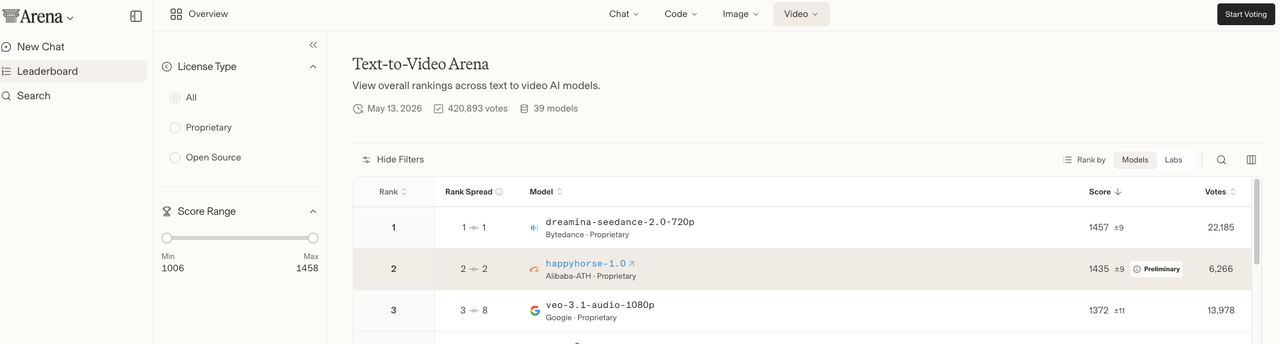
Snapshot of top ai video generators as of May 2026. Elo scores from the Artificial Analysis Text-to-Video Arena (with audio), pulled mid-May — third-party blind-vote data. Verify pricing and versions before committing.
| Model | Developer | Max Duration | Native Audio | AA Elo (T2V+audio) | Open Weights |
|---|---|---|---|---|---|
| Veo 3.1 | Google DeepMind | 8s (extendable) | Yes | 1100 | No |
| Sora 2 | OpenAI | 25s | Yes | n/a (sunsetting) | No |
| Kling 3.0 / 2.6 | Kuaishou | 10s | Yes | 1097 (3.0 Omni) | No |
| WAN 2.5 | Alibaba | 10s | Yes | leader on open-weights | Yes |
| Seedance 2.0 (Dreamina 720p) | ByteDance | 4–15s | Yes | 1213 (current #1) | No |
| Hailuo / MiniMax | MiniMax | 10s | Partial | n/a | No |
| LTX-2.3 Fast | Lightricks | 20s | Yes | 973 (open-weights lead) | Yes |
| Hunyuan Video | Tencent | ~5s | No | n/a | Yes |
Top AI Video Models Compared
The top video gen tools 2026 by adoption and capability. Run data where I have it.
Veo 3 — Google’s flagship; cinematic baseline
Veo 3.1, released October 15, 2025 with a 4K upgrade in January 2026, is the cinematic baseline. Native audio single-pass. 8s clips, extendable via scene chaining. Access via Gemini API, Vertex AI, or Google AI Pro / Ultra. Strong on physics and prompt adherence. Not cheap. Veo 3.1 Lite arrived March 2026.
My runs: 14/18 pass, 3 partial, 1 fail. Failures clustered on #5 (characters merged at frame 110 twice). Audio sync strongest of closed models.
Sora 2 — OpenAI; long-form coherence
Sora 2 is the awkward entry. Excellent model — 25s clips, synchronized audio, longest single-pass coherence of any closed model. The problem is access. OpenAI announced in March 2026 that the Sora app and API are sunsetting, API discontinued September 24, 2026. Not in my run set — no point benchmarking what you can’t ship on.
Kling 2.6 — strong motion control
Kuaishou released Kling 2.6 on December 3, 2025 as the first Kling with simultaneous audio-visual generation. 10s clips, 1080p, up to 48 FPS. The Elements feature combines up to four reference images for character consistency. Motion brush and first/last frame positioning give more direct control than Veo’s text-only approach. Kling 3.0 launched Feb 4, 2026 with longer clips and 4K; 2.6 has mature API coverage.
 My runs: 12/18 pass on 2.6. Motion-heavy prompts (#3 handheld, #6 fast motion) highest at 5/6 each. Lip-sync on #2 inconsistent.
WAN 2.5 — open-source-friendly with serious quality
WAN 2.5 from Alibaba’s Tongyi Lab is the open-source line worth taking seriously. The Wan series has accumulated millions of downloads on Hugging Face and ModelScope since Wan 2.1 went open-source in February 2025. 2.5 adds audio sync and 1080p. Apache 2.0. Self-hosting at 14B means real GPU costs; the 1.3B variant runs on one consumer card but quality drops. WAN’s appeal: open without compromising on quality, only on infrastructure ownership.
Seedance 2.0 — ByteDance; production speed
Seedance 2.0, released by ByteDance’s Seed team on February 9, 2026, introduces multi-modal input — text, image, audio, video, up to twelve files per generation. 4–15s clips, 1080p, multiple aspect ratios. API live on fal.ai April 2026 as preview. Currently #1 on the Artificial Analysis Text-to-Video Arena (with audio) at Elo 1213.
Standout: reference-to-video where you hand it a short clip of camera movement and a still image, and it produces a new clip with that camera move on that subject. No other closed model does this natively. My runs: 15/18 pass — highest of any model. Limitation: no global production API outside fal as of May 2026, and ByteDance paused some global rollout in March 2026 over IP disputes — verify commercial use in your jurisdiction.
Hailuo / MiniMax — character and motion consistency
MiniMax’s Hailuo line is the go-to for character-driven shorts. Less cinematic than Veo, less stylized than Kling, but identity holds across cuts in a way others struggle with at the same price. API documented, latency predictable. Not in my run set. Worth testing if your workflow involves the same character across clips.
LTX-2 — open-weights with consumer-GPU latency
Lightricks open-sourced LTX-2 on January 6, 2026 — full weights, training code, inference pipeline, Apache 2.0. 19B parameters. Native 4K at up to 50 FPS, 20s clips with synchronized audio. LTX-2.3 in March 2026 added a desktop editor. Leads open-weights on Artificial Analysis at Elo 973. My runs: 9/18 pass on local 19B. Quality lags closed leaders on motion; pick it for ownership, not raw score.
Open-source notables: Hunyuan Video, Mochi, Open-Sora, CogVideoX
Worth knowing they exist. Hunyuan (Tencent) is competitive on text-to-video but no native audio. Mochi 1 (Genmo) strong on motion, short clips. Open-Sora and CogVideoX are research-grade — useful for fine-tuning, not production. Not in my run set.
Access Path Comparison: Direct Provider vs Aggregation vs Self-Host
Three ways to call these models. Each has real trade-offs.
Direct provider APIs — when they make sense
Going direct — Gemini API for Veo, Kling’s API, MiniMax’s API — gives the cleanest contract: roadmap, pricing, SLA. Single model at volume: usually cheapest and most predictable. Downside: every new model is a new integration and rate limit dashboard.
Aggregation layers — what you gain and trade
Aggregators (fal.ai, Replicate) give one integration that fans out. Swap Veo for Seedance for Kling without rewriting. Trade: margin on per-second cost, occasional routing latency, dependence on whether the aggregator carries the version you need. Best for testing or letting users pick. Single-model at scale pushes back to direct.
Self-hosting open-source models — real cost considerations
People underestimate self-hosting costs. Paper: no per-second billing. Reality: an H100 running 24/7 for bursty workloads, plus engineering time for queueing, retries, monitoring. Break-even depends on duty cycle. Continuous high-throughput: self-host wins. Bursty workflows with idle time: API wins. Run the math.
Choosing the Right Model for Your Use Case
Short-form social video
Kling 2.6 or Seedance 2.0. Both have native 9:16, native audio, and 8–15s clip lengths that fit TikTok / Reels / Shorts without trimming.
Cinematic / ad creative
Veo 3.1. Physics realism and prompt adherence are the baseline others are measured against. Pair with scene extension for >8s ads.
Image-to-video animation
WAN 2.5 for self-host. Kling 2.6 for hosted API with character consistency. LTX-2 for 4K without per-second billing.
Long-form / multi-shot narrative
No model does this well single-pass yet. Chain short generations with consistent reference images. Veo 3.1’s scene extension is the cleanest. Sora 2 had the longest single-pass but is sunsetting.
FAQ
Which AI video generator gives the lowest cost per second of output?
Self-hosted open-source (WAN 2.5, LTX-2) at sustained high throughput. Among hosted APIs, Veo 3.1 Lite and Kling’s standard tier sit lower-mid. Effective cost matters more than list — factor in failure rate.
What evaluation dimensions matter most when choosing an AI video generator?
The six above: output quality, latency, unit cost, commercial use, API availability, throughput. If you can only check three, check unit cost, API availability, and commercial use — those break products in production, not in demos. Picking the best ai video generator without these checks is picking on demo footage.
Which AI video generator is best for short-form social video?
Kling 2.6 and Seedance 2.0. Native 9:16, native audio, clip lengths that fit social platforms without re-encoding. The best video generation ai here isn’t the highest-quality model — it’s the one that fits the spec and ships fast.
When should I use a direct provider API vs an aggregation layer?
Direct when at volume on a single model and need clean pricing and SLA. Aggregation when testing across models, letting users pick, or reducing integration surface area. Most teams start aggregated and migrate to direct on the one or two models they run heavily.
Bottom Line
The best ai video generator in 2026 isn’t a model — it’s a fit between output spec, access path, and unit economics. Seedance 2.0 leads my run set and the Artificial Analysis arena. Veo 3.1 wins on cinematic baseline and audio. Kling 2.6 wins on motion control. WAN 2.5 and LTX-2 win on ownership. Sora 2 is sunsetting.
Run the six-prompt rubric on two or three before committing. The leaderboard you trust should be your own.
Previous posts:
Related Articles
Free AI Video Generator No Watermark: 2026 Honest Guide

Grok Imagine Video 1.5: xAI's Image-to-Video Model With Native Audio
Reve 2.0: The Layout-First 4K Image Model Challenging GPT Image 2 and Nano Banana

AI Video Generation News: 2026 Latest Models & Updates
Open Source Face Swap Software: Top Models & Tools (2026)